
Market Overview:
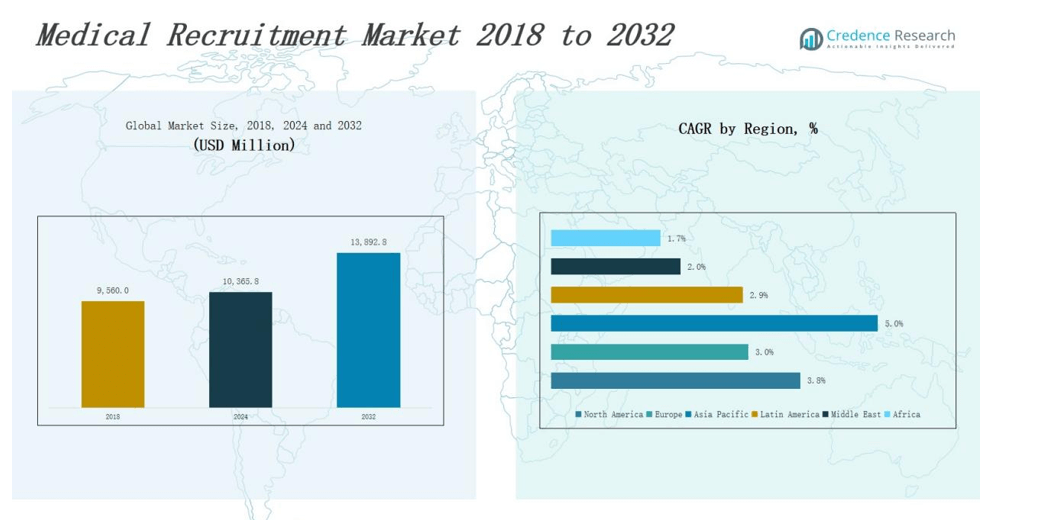
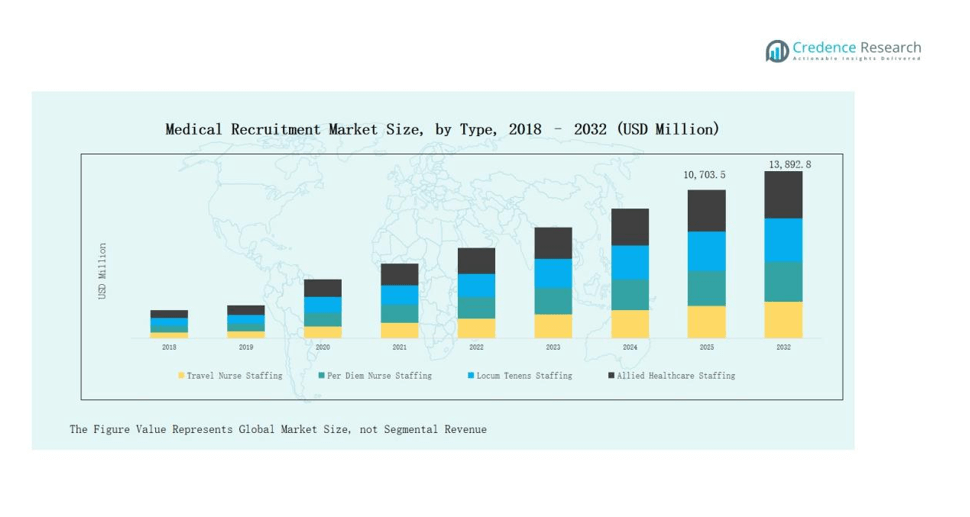
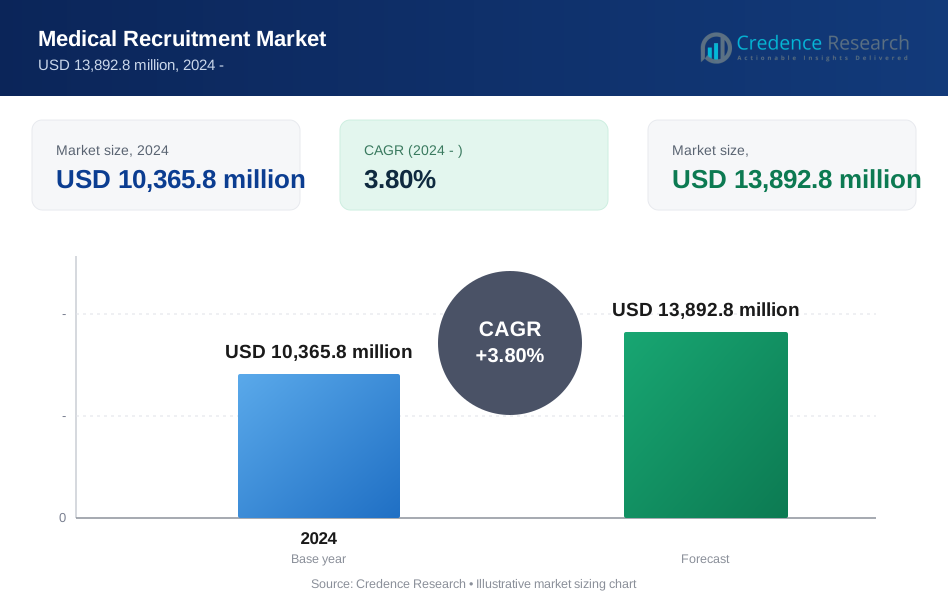
Medical Recruitment Market size was valued at USD 9,560.0 million in 2018 to USD 10,365.8 million in 2024 and is anticipated to reach USD 13,892.8 million by 2032, at a CAGR of 3.8% during the forecast period.
| REPORT ATTRIBUTE | DETAILS |
|---|---|
| Historical Period | 2020-2023 |
| Base Year | 2024 |
| Forecast Period | 2025-2032 |
| Medical Recruitment Market Size 2024 | USD 10,365.8 million |
| Medical Recruitment Market , CAGR | 3.8% |
| Medical Recruitment Market Size 2032 | USD 13,892.8 million |
The medical recruitment market is shaped by prominent players including AMN Healthcare, CHG Healthcare, Maxim Healthcare Services, LocumTenens.com, and Cross Country Healthcare. These companies focus on providing tailored staffing solutions, digital recruitment platforms, and global placement services to meet rising healthcare workforce needs. Strategic mergers, technology integration, and specialty-focused hiring strengthen their market presence. Regionally, North America dominates the medical recruitment market with a 41 percent share, supported by advanced healthcare infrastructure, high demand for skilled professionals, and strong adoption of recruitment process outsourcing models.
Market Insights
- The Medical Recruitment Market grew from USD 9,560.0 million in 2018 to USD 10,365.8 million in 2024, projected at USD 13,892.8 million by 2032.
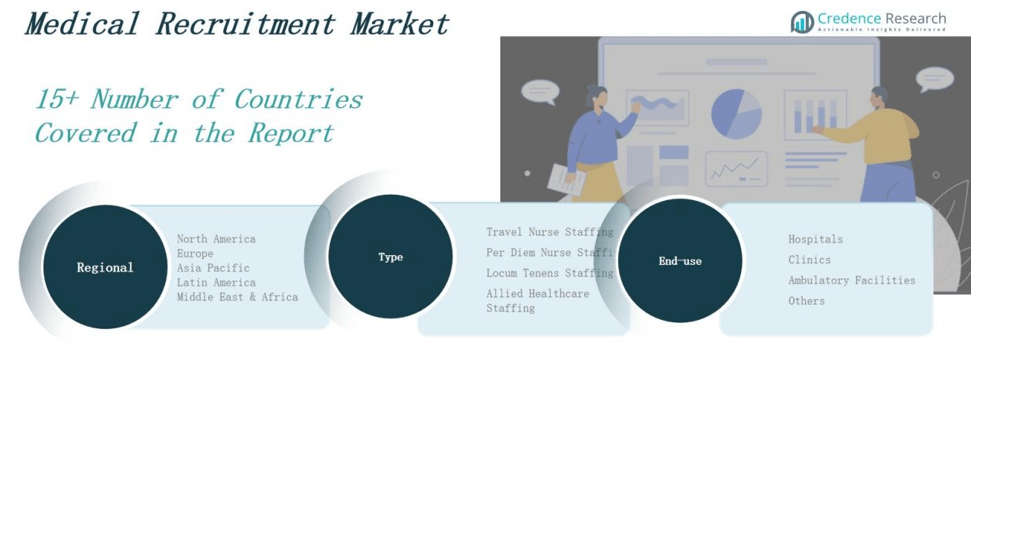
- Travel nurse staffing dominates type segmentation with 38% share, followed by per diem at 24%, locum tenens at 21%, and allied healthcare staffing at 17%.
- Hospitals lead the end-use segment with 46% share, clinics hold 26%, ambulatory facilities 18%, and others including long-term care and home healthcare account for 10%.
- North America commands 34% share, Europe 21%, Asia Pacific 23%, Latin America 8%, Middle East 7%, and Africa 7% of the global market in 2024.
- Leading players such as AMN Healthcare, CHG Healthcare, Maxim Healthcare Services, LocumTenens.com, and Cross Country Healthcare drive market growth through staffing solutions, technology integration, and global placement services.
Market Segment Insights
By Type
The type segment of the medical recruitment market is dominated by travel nurse staffing, which holds a 38% share. Rising nurse shortages, demand for flexibility, and seasonal workforce needs make this the leading category. Per diem nurse staffing accounts for 24%, driven by cost flexibility and short-term coverage requirements. Locum tenens staffing captures 21%, addressing physician shortages, especially in rural areas, while allied healthcare staffing holds 17%, supported by growing demand for therapists, technicians, and diagnostic specialists.
- For instance, Cross Country Healthcare expanded its allied staffing services in 2022 to meet rising demand for physical therapists as outpatient rehabilitation volumes grew post-pandemic.
By End-Use
Hospitals lead the end-use segment with a 46% share, supported by high patient volumes and acute care needs. Clinics follow with 26%, benefiting from demand for outpatient services and cost-effective care delivery. Ambulatory facilities represent 18%, reflecting the shift toward outpatient surgeries and minimally invasive procedures. The “Others” category, including long-term care and home healthcare, holds 10% of the market, supported by aging populations and growing demand for chronic disease management and home-based services.
- For instance, the Mayo Clinic (U.S.) reports over 1.3 million unique patients annually, reflecting the scale of hospital-based care.
Market Overview
Rising Healthcare Workforce Shortages
The medical recruitment market is driven by significant shortages of healthcare professionals across hospitals, clinics, and long-term care facilities. Aging populations, rising chronic disease prevalence, and expanding healthcare infrastructure create unprecedented demand for skilled staff. Countries face shortages of physicians and nurses, prompting facilities to rely on recruitment firms and staffing solutions to close workforce gaps. This imbalance drives consistent demand for medical recruitment services worldwide.
- For instance, the World Health Organization (2023) estimated a projected shortfall of 10 million health workers by 2030, disproportionately affecting low- and middle-income countries.
Increasing Demand for Flexible Staffing Models
Healthcare systems increasingly prefer flexible staffing solutions to manage unpredictable patient inflows and seasonal demands. Models such as travel nurse staffing, per diem assignments, and locum tenens are widely adopted. These approaches provide cost efficiency while ensuring continuity of patient care. Professionals also favor flexible roles for better work-life balance, creating a sustainable supply-demand cycle. The adaptability of these models strengthens their role as a major driver for the medical recruitment market.
Government Initiatives and Healthcare Spending
Growing government support for healthcare infrastructure expansion and staffing programs accelerates market growth. Developed nations implement policies to address workforce shortages, while emerging economies invest heavily in healthcare modernization. Rising public and private healthcare spending boosts recruitment demand, particularly in specialized areas such as critical care and diagnostics. Incentives for international recruitment and mobility also expand opportunities, making regulatory support a key driver of market expansion.
- For instance, the UK National Health Service (NHS) introduced its Long Term Workforce Plan (2023), targeting the largest-ever expansion in medical training, including doubling medical school places by 2031, to ensure sustainable staffing.
Key Trends & Opportunities
Integration of Digital Recruitment Platforms
A major trend shaping the medical recruitment market is the adoption of digital hiring platforms and AI-driven tools. Online systems streamline candidate sourcing, credential verification, and job-matching processes. These technologies improve efficiency, reduce hiring times, and ensure compliance with regulatory standards. As healthcare providers seek faster recruitment to address staff shortages, digital platforms present a strong opportunity for market players to differentiate and expand their reach.
- For instance, AMN Healthcare launched its AMN Passport app in 2021, enabling clinicians to search, apply, and onboard for travel nursing jobs directly from a mobile platform, significantly reducing application turnaround times.
Rising Demand for Allied Healthcare Professionals
Opportunities are emerging from the growing need for allied healthcare staff such as therapists, lab technicians, and diagnostic specialists. Expansion of ambulatory facilities, rehabilitation centers, and home healthcare services is driving this demand. Advances in medical technology and diagnostic equipment increase the reliance on skilled allied professionals. Recruitment firms that expand their services beyond physicians and nurses to include these roles are positioned to capture new growth opportunities in the market.
- For instance, Encompass Health, one of the largest rehabilitation providers, owns more than 160 inpatient rehabilitation hospitals staffed heavily with physical therapists, occupational therapists, and speech-language pathologists to support recovery and continuity of care.
Key Challenges
Regulatory and Compliance Barriers
The medical recruitment market faces significant regulatory challenges, including licensing requirements, cross-border credentialing, and varying labor laws. These complexities slow down recruitment processes and increase administrative costs for staffing agencies. Ensuring compliance with strict healthcare standards also demands investment in verification and monitoring systems. Such barriers limit operational efficiency and pose hurdles to international recruitment efforts.
High Attrition and Burnout Among Professionals
High turnover rates and professional burnout present major challenges in sustaining the healthcare workforce. Long working hours, stress, and limited incentives often lead to workforce dissatisfaction. Recruitment agencies face difficulties in retaining professionals once placed, resulting in repeated hiring cycles. This increases costs for providers and slows long-term workforce stabilization. Addressing burnout is critical for improving retention and ensuring consistent staffing availability.
Intense Market Competition
The medical recruitment market is highly competitive, with global firms and regional players competing for contracts. Price-based competition often reduces profit margins for staffing agencies. Established players leverage technology and global networks, making it harder for smaller firms to compete. At the same time, healthcare providers demand cost-effective solutions, pushing recruiters to deliver value-added services. This intense rivalry creates challenges in sustaining differentiation and profitability.
Regional Analysis
North America
North America leads the medical recruitment market with a 34% share in 2024, supported by advanced healthcare infrastructure and strong demand for skilled professionals. The region recorded revenues of USD 3,999.1 million in 2024, projected to reach USD 5,351.9 million by 2032 at a CAGR of 3.8%. The U.S. remains the largest contributor, driven by aging populations, high healthcare expenditure, and persistent staffing shortages across hospitals. Growing reliance on travel nurse staffing and locum tenens continues to fuel recruitment demand in this region.
Europe
Europe holds a 21% share of the medical recruitment market in 2024, with revenues of USD 2,412.9 million. The market is expected to grow moderately, reaching USD 3,039.1 million by 2032 at a CAGR of 3.0%. The region’s demand is shaped by aging demographics, government-backed healthcare initiatives, and workforce mobility across EU countries. Key markets such as Germany, the UK, and France lead recruitment activities, while southern European nations experience growing needs for allied healthcare professionals.
Asia Pacific
Asia Pacific captures a 23% share of the medical recruitment market in 2024, reporting revenues of USD 2,735.0 million. It is projected to expand strongly to USD 4,021.0 million by 2032, growing at a CAGR of 5.0%, the highest among all regions. Rapid urbanization, increasing healthcare investments, and shortages of skilled staff across China, India, and Southeast Asia drive this growth. The region offers opportunities for international recruitment agencies as demand for both physicians and allied healthcare staff surges.
Latin America
Latin America accounts for an 8% share of the medical recruitment market, generating USD 698.5 million in 2024. It is forecasted to reach USD 873.6 million by 2032, growing at a CAGR of 2.9%. Brazil and Argentina lead the regional market, supported by expanding private healthcare networks and rising medical tourism. However, shortages of qualified professionals and uneven healthcare infrastructure create persistent recruitment challenges, which increase reliance on staffing agencies.
Middle East
The Middle East holds a 7% share of the medical recruitment market in 2024, valued at USD 270.5 million. The market is projected to grow modestly to USD 314.1 million by 2032 at a CAGR of 2.0%. Strong demand for international professionals, particularly in GCC countries, drives market growth. Investments in advanced hospitals and specialty care facilities increase staffing requirements. However, regulatory barriers and regional instability limit faster expansion.
Africa
Africa represents a 7% share of the medical recruitment market in 2024, with revenues of USD 249.9 million. By 2032, the market is forecasted to reach USD 293.2 million, growing at a CAGR of 1.7%. The region’s growth is constrained by limited healthcare funding, infrastructure gaps, and brain drain of skilled professionals to developed economies. Nonetheless, rising investments in healthcare modernization and government support for training programs create gradual opportunities for recruitment agencies.
Market Segmentations:
By Type
- Travel Nurse Staffing
- Per Diem Nurse Staffing
- Locum Tenens Staffing
- Allied Healthcare Staffing
By End-Use
- Hospitals
- Clinics
- Ambulatory Facilities
- Others
By Region
- North America
- U.S.
- Canada
- Mexico
- Europe
- Germany
- France
- U.K.
- Italy
- Spain
- Rest of Europe
- Asia Pacific
- China
- Japan
- India
- South Korea
- South-east Asia
- Rest of Asia Pacific
- Latin America
- Brazil
- Argentina
- Rest of Latin America
- Middle East & Africa
- GCC Countries
- South Africa
- Rest of the Middle East and Africa
Competitive Landscape
The medical recruitment market is highly competitive, with a mix of global staffing firms and specialized healthcare recruitment agencies shaping industry dynamics. Leading players include Adecco Group, Randstad N.V., AMN Healthcare, CHG Healthcare, Maxim Healthcare Services, and ManpowerGroup, alongside regional specialists such as Medacs Healthcare, Hays plc, and Robert Walters. These companies focus on expanding service portfolios covering travel nurse staffing, locum tenens, allied healthcare, and per diem placements to address diverse workforce demands. Strategic growth is driven by technology adoption, including AI-enabled recruitment platforms and digital workforce management tools, which streamline hiring processes and credential verification. Partnerships with healthcare providers and cross-border recruitment initiatives further enhance market presence. Intense competition encourages firms to differentiate through tailored solutions, faster placement services, and compliance expertise. Market leaders also invest in mergers, acquisitions, and international expansions to strengthen geographic reach and secure long-term contracts with hospitals, clinics, and ambulatory facilities worldwide.
Key Players
- Adecco Group
- Randstad N.V. (Netherlands)
- Kelly Services Inc. (U.S.)
- ManpowerGroup (U.S.)
- Recruit Holdings Co., Ltd. (Japan)
- Hays plc (U.K.)
- Maxim Healthcare Services (U.S.)
- CHG Management, Inc. (U.S.)
- Medacs Healthcare (U.K.)
- Barton Associates (U.S.)
- Allegis Group (U.S.)
- Morgan McKinley (Ireland)
- Robert Walters Plc. (U.K.)
- Korn Ferry (U.S.)
- Jackson Healthcare (U.S.)
- TeamHealth (U.S.)
- AMN Healthcare (U.S.)
Recent Developments
- In August 2025, Workday announced its acquisition of Paradox, an AI-powered conversational recruitment platform. The deal aims to enhance Workday’s talent acquisition tools by improving candidate engagement with instant response, self-scheduling, and 24/7 support.
- In November 2024, GQR Life Sciences partnered with Nebula, an AI-driven talent platform. The partnership focuses on integrating advanced AI tools, including natural language processing, into recruitment processes. It provides biopharma clients access to over 180 million profiles and automated sourcing to reduce time-to-hire.
- on August 13, 2025, StaffDNA® launched DNAInsights, a new technology providing real-time market data and pay rate comparisons to help healthcare organizations track workforce trends and improve hiring efficiency.
- In November 2024, HealthEdge partnered with Codoxo. This strategic partnership focuses on bringing next-generation GenAI tools to healthcare payers and recruiters
Market Concentration & Characteristics
The medical recruitment market demonstrates moderate concentration, with a few global firms holding significant shares alongside numerous regional and niche agencies. Large players such as Adecco Group, Randstad N.V., AMN Healthcare, and ManpowerGroup dominate through extensive networks, diversified staffing solutions, and strong client relationships. It is characterized by high competition, where technology adoption and international reach serve as key differentiators. Specialized firms focus on locum tenens, travel nurses, and allied healthcare to capture growing demand in specific segments. The market reflects a strong dependence on demographic trends, including aging populations and rising chronic disease prevalence, which sustain the need for continuous staffing. Healthcare providers seek cost-efficient and flexible workforce models, reinforcing the importance of contract-based placements. Regulatory compliance, licensing requirements, and cross-border recruitment policies shape operational strategies. The industry exhibits steady growth potential, with digital recruitment platforms and global mobility driving structural shifts in service delivery and client engagement.
Report Coverage
The research report offers an in-depth analysis based on Type, End-Use and Region. It details leading market players, providing an overview of their business, product offerings, investments, revenue streams, and key applications. Additionally, the report includes insights into the competitive environment, SWOT analysis, current market trends, as well as the primary drivers and constraints. Furthermore, it discusses various factors that have driven market expansion in recent years. The report also explores market dynamics, regulatory scenarios, and technological advancements that are shaping the industry. It assesses the impact of external factors and global economic changes on market growth. Lastly, it provides strategic recommendations for new entrants and established companies to navigate the complexities of the market.
Future Outlook
- Travel nurse staffing demand will rise further, driven by shortages and increasing healthcare service pressures.
- Digital recruitment platforms will streamline hiring, offering faster placements and improved compliance for healthcare providers.
- International recruitment will expand significantly, filling workforce gaps in regions facing acute shortages of professionals
- Allied healthcare staffing will grow steadily, supported by rising rehabilitation, diagnostics, and specialized outpatient service needs.
- Hospitals will remain the primary recruiters, requiring continuous staffing to manage acute and critical patient care.
- Clinics and ambulatory facilities will increasingly adopt flexible staffing models to meet fluctuating patient demands.
- Regulatory compliance will strongly influence recruitment processes, requiring agencies to adapt quickly to evolving standards.
- Strategic mergers and acquisitions will help leading players expand global presence and service delivery capabilities.
- Workforce retention strategies will gain importance, aiming to address burnout and reduce frequent staff turnover.
- Emerging markets will create opportunities for global recruitment firms as healthcare investments and infrastructure expand.
Request a Free Sample
Fill in your details and we'll send you a free sample report.
- Sample data tables & charts
- Research methodology
Need a Custom Version of This Report?
Tailor the scope, geography, or segments to your exact requirements.
- Custom geography or segment scope
- Direct access to our analyst team
Frequently Asked Questions
What is the current size of the Medical Recruitment Market?
What factors are driving the growth of the Medical Recruitment Market?
What are the key segments within the Medical Recruitment Market?
What are some challenges faced by the Medical Recruitment Market?
Who are the major players in the Medical Recruitment Market?
Table of Content
Chapter 1. Report Introduction
- 1.1 Report Description & Purpose
- 1.1.1 Report Title & Market Definition
- 1.1.2 Unique Selling Propositions (USP) & Key Differentiators
- 1.1.3 Value Proposition for Stakeholders
- 1.2 Research Objectives
- 1.2.1 Market Sizing Objectives (Volume & Revenue)
- 1.2.2 Segmentation Objectives
- 1.2.3 Competitive Intelligence Objectives
- 1.2.4 Forecast & Scenario Objectives
- 1.3 Report Scope
- 1.3.1 Medical Recruitment Scope – Types & Subtypes Covered
- 1.3.2 Geographic Scope – Regions & Countries Covered
- 1.3.3 Historical Period, Base Year & Forecast Period (2024; forecast to the forecast period)
- 1.3.4 Inclusions & Exclusions
- 1.4 HS Code & Classification Framework
- 1.5 Currency, Units & Pricing Basis
- 1.6 Target Stakeholders
- 1.7 Limitations & Assumptions
Chapter 2. Executive Summary
- 2.1 Global Medical Recruitment Market Snapshot
- 2.1.1 Market Size – Historical (2024) & Forecast (the forecast period) (2024: USD 10,365.8 million → forecast year: USD 13,892.8 million)
- 2.1.2 Volume & Revenue – Global Totals
- 2.1.3 Key Market Highlights – Top Five Facts
- 2.2 Medical Recruitment Market Segmentation Snapshot
- 2.2.1 Market Split by Region – 2024 vs.
- 2.3 Competitive Snapshot
- 2.3.1 Top 10 Players by Revenue Share – 2024
- 2.3.2 Top 10 Players by Volume Share – 2024
- 2.3.3 Recent Strategic Developments (18-Month Summary)
- 2.4 Key Investment Highlights & Strategic Conclusions
Chapter 3. Medical Recruitment Market Dynamics & Industry Analysis
- 3.1 Market Overview & Context
- 3.1.1 Medical Recruitment Market Position in the Broader Automotive Value Chain
- 3.1.2 OEM vs. Replacement Market Dynamics
- 3.1.3 Market Maturity & Development Stage by Region
- 3.2 Medical Recruitment Market Drivers
- 3.3 Medical Recruitment Market Restraints & Challenges
- 3.4 Medical Recruitment Market Opportunities
- 3.5 Porter's Five Forces Analysis
- 3.5.1 Threat of New Entrants
- 3.5.2 Bargaining Power of Suppliers
- 3.5.3 Bargaining Power of Buyers
- 3.5.4 Threat of Substitutes
- 3.5.5 Competitive Rivalry – Intensity Assessment
- 3.6 Medical Recruitment Value Chain Analysis
- 3.6.1 Upstream – Raw Material/Input Suppliers
- 3.6.1.1 Raw Material/Input 1
- 3.6.1.2 Raw Material/Input 2
- 3.6.1.3 Raw Material/Input 3
- 3.6.2 Midstream – Production/Manufacturing/Service Delivery
- 3.6.2.1 Production/Process Overview
- 3.6.2.2 Key Facility Locations & Capacity by Manufacturer
- 3.6.3 Downstream – Distribution & End Consumer
- 3.6.3.1 Primary Channel – B2B/OEM
- 3.6.3.2 Secondary Channels – Dealer, Retail, Online, Direct
- 3.6.4 Value Chain Profitability Analysis
- 3.6.1 Upstream – Raw Material/Input Suppliers
- 3.7 PESTEL Analysis
- 3.7.1 Political Factors
- 3.7.2 Economic Factors
- 3.7.3 Social Factors
- 3.7.4 Technological Factors
- 3.7.5 Environmental Factors
- 3.7.6 Legal Factors
- 3.8 Medical Recruitment Supply Chain Analysis
- 3.8.1 Raw Material/Input Supply Risk Assessment
- 3.8.2 Manufacturing Concentration Risk (Geographic Exposure)
- 3.8.3 Trade Disruption Impact Analysis
- 3.9 Regulatory & Policy Landscape
Note: The regulatory and policy landscape section covers regulations based on their applicability to the market, Medical Recruitment category, geography, and scope of the study. Only regulatory frameworks with a material impact on operations, compliance, trade, sustainability, or market access are analyzed in detail.
Chapter 4. Key Investment Pockets & Opportunity Analysis
- 4.1 Medical Recruitment Market Attractiveness Analysis
- 4.1.1 By Region – Investment Attractiveness Matrix (Volume × CAGR)
- 4.2 Absolute Revenue Growth Opportunity
- 4.2.1 By Region – Absolute USD Growth Through the forecast period
- 4.3 Incremental Volume Opportunity
- 4.3.1 By Region – Incremental Volume Through the forecast period
- 4.3.2 Segment – Incremental Volume
- 4.4 Emerging Submarket Opportunity Deep Dive (Subject to Applicability)
- 4.5 Emerging Market Opportunity Scorecards
- 4.5.1 United States
- 4.5.2 Europe
- 4.5.3 Asia
- 4.5.4 Middle East & Africa
Note: Emerging Market Opportunity Scorecards will be included based on relevance and strategic importance. Regions listed are indicative and may vary depending on data availability and market dynamics.
Chapter 5. Medical Recruitment Import-Export Analysis & Trade Flows
- 5.1 Global Trade Overview
- 5.1.1 Global Export Value by Country (2024)
- 5.1.2 Global Export Volume by Country (2024)
- 5.1.3 Global Import Value by Country (2024)
- 5.1.4 Global Import Volume by Country (2024)
- 5.1.5 Net Trade Balance by Country (2024)
- 5.2 Export Analysis – Segment
- 5.2.1 Type 1 (HS Code)
- 5.2.2 Type 2 (HS Code)
- 5.2.3 Type 3 (HS Code)
- 5.2.4 Type 4 (HS Code)
- 5.2.5 Type 5 (HS Code)
- 5.3 Import Analysis – Segment
- 5.3.1 Type 1 (HS Code)
- 5.3.2 Type 2 (HS Code)
- 5.3.3 Type 3 (HS Code)
- 5.3.4 Type 4 (HS Code)
- 5.3.5 Type 5 (HS Code)
- 5.4 Average Unit Trade Prices
- 5.4.1 Average Export Price – Segment & Country
- 5.4.2 Average Import Price – Segment & Source Country
- 5.4.3 Price Trends (2024)
- 5.5 Key Trade Route Analysis
- 5.5.1 Trade Route 1
- 5.5.2 Trade Route 2
- 5.5.3 Trade Route 3
- 5.5.4 Trade Route 4
- 5.5.5 Trade Route 5
- 5.6 Trade Policy Impact Assessment
- 5.6.1 US Anti-Dumping & Section 301 Tariffs
- 5.6.2 EU Customs Union Impact
- 5.6.3 Major Free Trade Agreements
- 5.6.4 USMCA Rules of Origin
Note: Trade policy analysis will be included only where relevant to the Medical Recruitment market.
Chapter 6. Competitive Landscape & Company Benchmarking
- 6.1 Medical Recruitment Market Concentration & Structure
- 6.1.1 Herfindahl-Hirschman Index (HHI) – vs. 2024
- 6.1.2 Tier 1, Tier 2 & Tier 3 Market Structure
- 6.1.3 Global, Regional & Local Player Dynamics
- 6.2 Medical Recruitment Market Share Analysis – 2024
- 6.2.1 Global Revenue Share by Company
- 6.2.2 Global Volume Share by Company
- 6.2.3 Regional Revenue Share
- 6.2.4 Market Share Evolution ( vs. 2024)
- 6.2.5 OEM Segment Share by Company
- 6.2.6 Replacement Segment Share by Company
- 6.3 Production/Delivery Capacity & Facility Analysis
- 6.3.1 Global Installed Capacity
- 6.3.2 Capacity Utilization Rates
- 6.3.3 Production/Output Volume
- 6.3.4 Facility Locations & Capacity Map
- 6.3.5 Planned Capacity Additions
- 6.4 Medical Recruitment Competitive Benchmarking Matrix
- 6.4.1 Revenue, Volume, CAGR & Profitability Comparison
- 6.4.2 Channel Revenue Mix
- 6.4.3 Geographic Revenue Exposure
- 6.4.4 R&D Intensity
- 6.4.5 Sustainability Maturity
- 6.5 Strategic Developments in Medical Recruitment (Last 24 Months)
- 6.5.1 Mergers, Acquisitions & Divestments
- 6.5.2 New Medical Recruitment Launches
- 6.5.3 Facility Expansions
- 6.5.4 Strategic Alliances, Joint Ventures & Partnerships
- 6.5.5 Distribution Expansion & Market Entry
- 6.5.6 Sustainability & ESG Initiatives
- 6.6 Competitive Strategy Mapping
- 6.6.1 Leader, Challenger, Follower & Niche Classification
- 6.6.2 Pricing Strategy Comparison
- 6.6.3 Channel Strategy Matrix
Note: Strategic developments are included based on their materiality and the availability of reliable information.
Chapter 7. Global Medical Recruitment Market – By Distribution Channel
- 7.1 Segment Overview
- 7.1.1 Volume & Revenue Split by Channel (2024 & )
- 7.1.2 Channel Mix Evolution (the forecast period)
Chapter 8. Regional Market Analysis – Global Overview
- 8.1 Global Regional Overview
- 8.1.1 Regional Volume Share
- 8.1.2 Regional Revenue Share
- 8.1.3 Regional Volume by Region
- 8.1.4 Regional Revenue by Region
- 8.1.5 Regional Forecast Through the forecast period
- 8.2 Cross-Regional Segment Analysis
- 8.2.1 By Distribution Channel
- 8.2.2 By Brand/Price Tier
Chapter 9. North America Medical Recruitment Market
- 9.1 United States
- 9.2 Canada
- 9.3 Mexico
Chapter 10. Europe Medical Recruitment Market
- 10.1 Germany
- 10.2 France
- 10.3 Italy
- 10.4 United Kingdom
- 10.5 Spain
- 10.6 Poland
- 10.7 Russia
- 10.8 Netherlands
- 10.9 Belgium
- 10.10 Sweden
- 10.11 Denmark
- 10.12 Norway
- 10.13 Rest of Europe
Chapter 11. Asia Pacific Medical Recruitment Market
- 11.1 China
- 11.2 India
- 11.3 Japan
- 11.4 South Korea
- 11.5 Thailand
- 11.6 Indonesia
- 11.7 Vietnam
- 11.8 Malaysia
- 11.9 Australia
- 11.10 Rest of Asia Pacific
Chapter 12. Latin America Medical Recruitment Market
- 12.1 Brazil
- 12.2 Argentina
- 12.3 Colombia
- 12.4 Chile
- 12.5 Rest of Latin America
Chapter 13. Middle East Medical Recruitment Market
- 13.1 Saudi Arabia
- 13.2 United Arab Emirates
- 13.3 Turkey
- 13.4 Israel
- 13.5 Iran
- 13.6 Rest of the Middle East
Chapter 14. Africa Medical Recruitment Market
- 14.1 South Africa
- 14.2 Egypt
- 14.3 Nigeria
- 14.4 Morocco
- 14.5 Rest of Africa
Chapter 15. Medical Recruitment Company Profiles
- 15.1 [Company 01]
- 15.1.1 Company Overview
- 15.1.2 Key Management Personnel
- 15.1.3 Products & Services Portfolio
- 15.1.4 Financial Performance
- 15.1.5 Key Market Focus & Geographic Presence
- 15.1.6 Recent Developments & Strategic Initiatives
Note: The company profile list is preliminary and may change based on research findings, market developments, data availability, and client requirements.
Chapter 16. Appendices
- Appendix A – List of Abbreviations & Acronyms
- Appendix B – Industry Classification Code Reference – Full Series
- Appendix C – Production & Capacity Data Tables
- Appendix D – End-Use & Demand Base Tables
- Appendix E – Consumption & Replacement Rate Assumptions
- Appendix F – ASP Reference Tables
- Appendix G – Manufacturing & Facility Database
- Appendix H – Import-Export Data Tables
- Appendix I – Regulatory Summary Tables
- Appendix J – Primary Research Participant List (Anonymized)
- Appendix K – Primary Research Questionnaire Framework
- Appendix L – Data Sources & Bibliography
- Appendix M – Market Size Divergence & Source Comparison
Chapter 17. Research Methodology
- 17.1 Research Framework & Philosophy
- 17.2 Secondary Research – Sources, Hierarchy & Data Extraction
- 17.3 Data Modeling – Bottom-Up & Top-Down Market Sizing
- 17.4 Primary Research – Stakeholder Framework, LOI & Sample Sizes
- 17.5 Forecast Methodology – Regression, Scenario & Sensitivity Analysis
- 17.6 Quality Control – Four-Layer Validation Framework
- 17.7 Limitations & Standard Assumptions
- 17.8 Disclaimer
