
Metal Thermos Flask Market Overview:
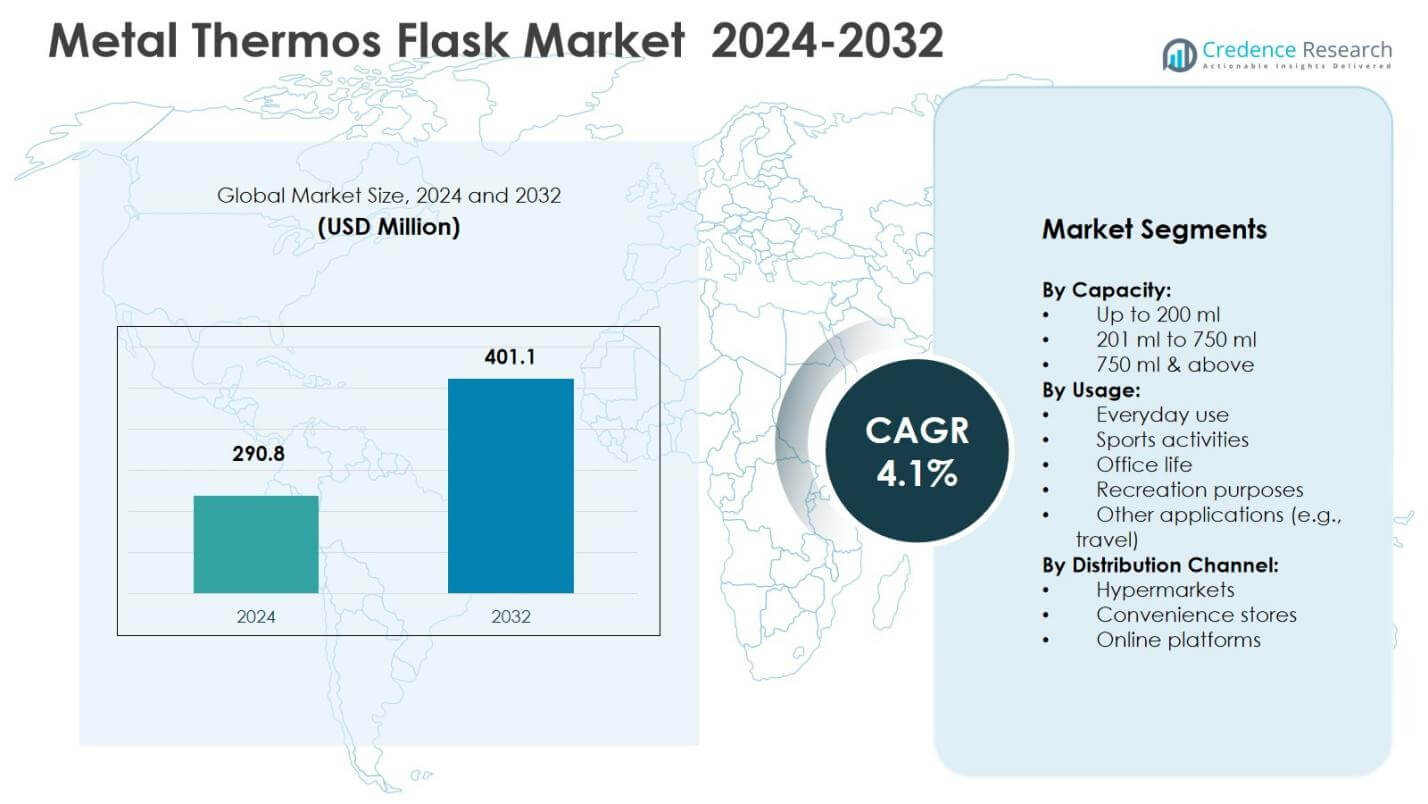
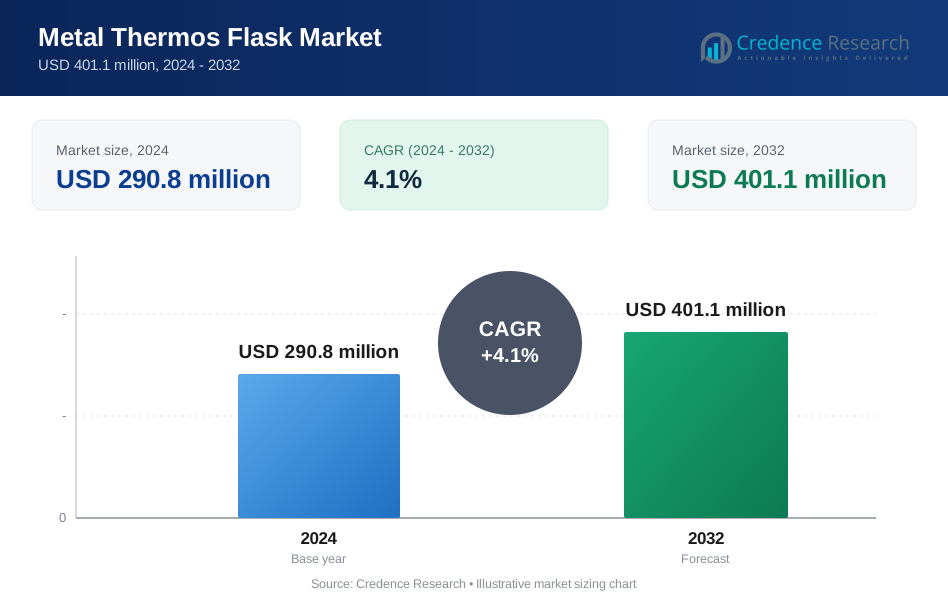
The Metal Thermos Flask Market size was valued at USD 290.8 million in 2024 and is anticipated to reach USD 401.1 million by 2032, expanding at a CAGR of 4.1% during the forecast period.
| REPORT ATTRIBUTE | DETAILS |
|---|---|
| Historical Period | 2020-2023 |
| Base Year | 2024 |
| Forecast Period | 2025-2032 |
| Metal Thermos Flask Market Size 2024 | USD 290.8 million |
| Metal Thermos Flask Market, CAGR | 4.1% |
| Metal Thermos Flask Market Size 2032 | USD 401.1 million |
Metal Thermos Flask Market Insights
- Market growth is primarily driven by rising health and hydration awareness, increasing adoption of reusable products, and growing demand for temperature-retentive beverage solutions across office, travel, and fitness applications, with the 201 ml to 750 ml capacity segment holding 46.8% share in 2024 due to its versatility.
- Ongoing trends include premiumization, advanced insulation technologies, leak-proof designs, and strong penetration of online platforms, which accounted for 7% distribution share in 2024, supporting wider product access and brand visibility.
- Market structure remains moderately fragmented, with leading brands focusing on product differentiation, lifestyle branding, sustainability positioning, and digital expansion, while price sensitivity and low-cost local alternatives act as key market restraints.
- Regionally, Asia Pacific led with 38.4% market share in 2024, followed by North America at 27.1%, Europe at 22.6%, Latin America at 7.1%, and Middle East & Africa at 4.8%, reflecting varied adoption patterns and income levels.
Metal Thermos Flask Market Segmentation Analysis:
By Capacity:
The Metal Thermos Flask Market by capacity is led by the 201 ml to 750 ml segment, which accounted for 46.8% market share in 2024, driven by its versatility across office, travel, and fitness use cases. This capacity range offers an optimal balance between portability and liquid retention, making it suitable for daily hydration needs. The up to 200 ml segment holds 28.1% share, supported by demand for compact flasks among commuters and children, while the 750 ml & above segment captured 25.1%, fueled by outdoor, trekking, and long-duration travel applications.
- For instance, Stanley's Adventure To-Go Thermal Flask at 750 ml uses vacuum insulation to keep beverages hot for 20 hours and cold for 25 hours, ideal for office or travel portability.
By Usage:
By usage, everyday use dominated the Metal Thermos Flask Market with a 41.6% market share in 2024, supported by rising health awareness, increased hot beverage consumption, and growing replacement of plastic bottles. Regular office commuting and household adoption continue to reinforce demand. Office life accounted for 21.9% share, driven by corporate sustainability initiatives, while sports activities held 17.4%, supported by fitness trends. Recreation purposes captured 12.3%, and other applications including travel contributed 6.8%, reflecting niche but steady demand.
- For instance, Yeti recommends its 18 oz Rambler Bottle with HotShot Cap for office commuting, fitting cup holders and staying leakproof for hot beverages.
By Distribution Channel:
The distribution landscape is dominated by online platforms, which accounted for 38.7% market share in 2024, driven by wider product selection, competitive pricing, and growing e-commerce penetration. Digital channels benefit from brand visibility, customer reviews, and customization options. Hypermarkets followed with a 31.4% share, supported by impulse buying and in-store promotions. Convenience stores captured 19.6%, driven by accessibility and quick purchases, while remaining share is distributed among specialty and other retail formats supporting premium and lifestyle-oriented flask products.
Key Growth Drivers
Rising Health and Hydration Awareness
Growing awareness around health, wellness, and daily hydration is a key driver of the Metal Thermos Flask Market. Consumers increasingly seek products that help maintain beverage temperature for longer durations, supporting consistent water, tea, and coffee consumption throughout the day. Metal thermos flasks enable hygienic, safe, and convenient hydration across workplaces, educational institutions, and fitness environments. The rising adoption among working professionals, students, and health-conscious individuals, combined with increasing participation in fitness and outdoor activities, continues to strengthen demand and supports steady market growth globally.
- For instance, Stanley's Quencher H2.0 FlowState Tumbler keeps hot drinks hot for 7 hours and cold drinks cold for 11 hours, appealing to health-conscious users who value prolonged temperature retention for daily hydration.
Shift Toward Sustainable and Reusable Products
The accelerating transition toward sustainable lifestyles is significantly boosting demand in the Metal Thermos Flask Market. Consumers are actively reducing dependence on single-use plastic bottles, favoring reusable metal alternatives that align with environmental goals. Stainless steel thermos flasks offer durability, recyclability, and long service life, making them an attractive eco-friendly option. Government regulations on plastic waste, corporate sustainability initiatives, and rising environmental awareness among younger consumers are collectively driving adoption, positioning metal thermos flasks as a preferred solution for responsible beverage consumption.
- For instance, Nalgene converted its reusable bottle production to Tritan Renew material, made from 50% certified recycled content, completing the switch by January 2023 after repurposing over 2.35 million pounds of plastic waste.
Expansion of Urbanization and On-the-Go Lifestyles
Rapid urbanization and increasingly fast-paced lifestyles are fueling demand for portable beverage storage solutions. Longer commuting hours, hybrid work models, and frequent travel have increased the need for reliable products that maintain beverage temperature during transit. Metal thermos flasks meet these requirements by offering portability, spill resistance, and durability. Additionally, growth in outdoor recreation, travel, and leisure activities further supports adoption, as consumers prioritize convenience and performance in daily-use hydration products.
Key Trends & Opportunities
Product Innovation and Premiumization
Product innovation is emerging as a major trend and opportunity in the Metal Thermos Flask Market. Manufacturers are focusing on advanced insulation technologies, leak-proof designs, lightweight materials, and enhanced thermal retention to differentiate offerings. Premiumization through aesthetic designs, color variations, and ergonomic features is attracting style-conscious consumers. Customization options for corporate gifting and branding further expand market opportunities. These innovations enhance user experience, improve functionality, and allow brands to target higher-margin segments, supporting long-term revenue growth.
- For instance, Stanley introduced QuadVac™ technology in its Master Unbreakable Water Bottle, featuring four layers of insulation including a stainless steel vacuum-treated lid that provides thermal retention of over 20 to 40 hours.
Growth of E-Commerce and Digital Retail Channels
The rapid expansion of e-commerce platforms presents a significant opportunity for market growth. Online channels provide access to a wider product range, competitive pricing, and detailed product comparisons, influencing purchase decisions. Increased smartphone penetration and digital payment adoption further support online sales. Brands benefit from direct-to-consumer models, customer feedback, and targeted digital marketing. This trend enables broader market reach, especially in emerging economies, while supporting faster product launches and improved brand visibility.
- For instance, Unilever's eB2B platform in emerging markets like Indonesia and Vietnam processes 75,000 orders daily, supporting annualized sales of €2.5 billion as of 2025. It connects 500,000 micro-retailers with AI-driven tools for efficient order fulfillment and real-time service.
Key Challenges
Price Sensitivity and Intense Market Competition
Price sensitivity among consumers poses a notable challenge in the Metal Thermos Flask Market. The presence of numerous local and unorganized players offering low-cost alternatives intensifies competition and pressures profit margins. Consumers often compare products based on price rather than performance, making differentiation difficult for premium brands. This competitive environment forces manufacturers to balance quality, innovation, and affordability while maintaining brand value and profitability across diverse regional markets.
Raw Material Cost Volatility and Supply Chain Constraints
Fluctuations in raw material prices, particularly stainless steel, present challenges for manufacturers. Variability in material costs impacts production expenses and pricing strategies, affecting overall profitability. Additionally, supply chain disruptions, logistics delays, and dependency on global sourcing can hinder consistent production and timely delivery. Managing these risks requires efficient sourcing strategies, inventory management, and cost optimization, which can be challenging for small and mid-sized manufacturers operating in highly competitive markets.
Regional Analysis
North America
North America accounted for 27.1% market share in 2024 in the Metal Thermos Flask Market, driven by high consumer awareness of health, hydration, and sustainability. Strong demand from office professionals, fitness enthusiasts, and travelers supports consistent consumption across the United States and Canada. The region benefits from widespread adoption of premium insulated products, strong brand presence, and high purchasing power. Growth is further supported by corporate sustainability initiatives and the replacement of disposable plastic bottles. Expanding e-commerce penetration and product innovation focused on durability and design continue to strengthen regional market performance.
Europe
Europe held a 22.6% market share in 2024, supported by stringent environmental regulations and strong consumer preference for reusable and eco-friendly products. Countries such as Germany, the United Kingdom, and France drive demand through high adoption of stainless steel flasks in workplaces and outdoor activities. Sustainability-focused consumer behavior and government-led plastic reduction policies significantly boost market growth. The region also shows strong demand for premium and aesthetically designed thermos flasks. Increasing travel, cycling culture, and recreational activities further contribute to steady demand across both Western and Northern European markets.
Asia Pacific
Asia Pacific dominated the Metal Thermos Flask Market with a 38.4% market share in 2024, driven by large population base, rapid urbanization, and strong cultural preference for hot beverages. China, India, and Japan represent key growth markets due to rising disposable incomes and expanding middle-class populations. Increasing health awareness, growing office workforce, and strong penetration of online retail platforms support high sales volumes. Local manufacturing capabilities and competitive pricing enhance accessibility across urban and semi-urban areas. The region also benefits from rising travel, education, and fitness activities, sustaining long-term market expansion.
Latin America
Latin America captured 7.1% market share in 2024, supported by gradual adoption of reusable beverage containers across Brazil, Mexico, and Argentina. Growing awareness of sustainability and rising participation in outdoor and recreational activities contribute to market development. Urban population growth and improving retail infrastructure support increased availability of metal thermos flasks. Price sensitivity remains a key factor, driving demand toward mid-range products. Expansion of e-commerce platforms and rising exposure to global lifestyle trends are improving product penetration, creating steady growth opportunities across both residential and commercial consumer segments in the region.
Middle East & Africa
The Middle East & Africa region accounted for 4.8% market share in 2024, driven by rising urbanization and increasing demand for temperature-retentive beverage solutions in hot climates. Growing adoption among office workers, travelers, and outdoor users supports market growth, particularly in the Gulf countries. Tourism, long commuting distances, and outdoor work environments increase reliance on insulated flasks. While market penetration remains moderate, improving retail networks and growing awareness of reusable products are strengthening demand. Premium products gain traction in developed markets, while affordability drives adoption in emerging African economies.
Metal Thermos Flask Market Segmentations:
By Capacity:
- Up to 200 ml
- 201 ml to 750 ml
- 750 ml & above
By Usage:
- Everyday use
- Sports activities
- Office life
- Recreation purposes
- Other applications (e.g., travel)
By Distribution Channel:
- Hypermarkets
- Convenience stores
- Online platforms
By Geography
- North America
- U.S.
- Canada
- Mexico
- Europe
- Germany
- France
- U.K.
- Italy
- Spain
- Rest of Europe
- Asia Pacific
- China
- Japan
- India
- South Korea
- South-east Asia
- Rest of Asia Pacific
- Latin America
- Brazil
- Argentina
- Rest of Latin America
- Middle East & Africa
- GCC Countries
- South Africa
- Rest of the Middle East and Africa
Competitive Landscape
Competitive landscape of the Metal Thermos Flask Market is characterized by the presence of well-established global brands such as Thermos LLC, YETI Holding Inc., Hydro Flask (Helen of Troy Limited), Stanley (PMI Worldwide), Klean Kanteen, Contigo, S’well, CamelBak, Zojirushi Corporation, and Mira Brands, alongside several regional and private-label manufacturers. Market participants compete primarily on insulation performance, product durability, design aesthetics, and brand positioning. Leading players focus on continuous product innovation, premium materials, and lifestyle-oriented branding to strengthen customer loyalty. Strategic expansions through e-commerce channels, influencer marketing, and sustainability-driven messaging further enhance competitiveness. Companies are also emphasizing customization, leak-proof technology, and lightweight designs to address evolving consumer preferences. The market remains moderately fragmented, with intense competition across price tiers, while strong brand recognition and distribution reach serve as key differentiators in maintaining market presence and expanding global footprint.
Key Player Analysis
- Stanley (PMI Worldwide)
- Zojirushi Corporation
- Thermos LLC
- Mira Brands
- YETI Holding Inc.
- Contigo
- Hydro Flask (Helen of Troy Limited)
- CamelBak
- S’well
- Klean Kanteen
Recent Developments
- In October 2025, Thermos® brand introduced the TrueTimber™ Strata Camo Collection, expanding its range of insulated metal drinkware products with a rugged design targeting outdoor and lifestyle consumers.
- In March 2025, Thermos® Brand expanded its product line with the Icon™ Series lightweight water bottles and flasks, enhancing its metal thermos and hydration offerings for daily use and travel.
- In June 2025, Stanley 1913 launched a limited-edition collaboration with artist Post Malone, releasing exclusive drinkware items including tumblers, a flask, and other insulated metal products available from June 16, 2025.
- In September 2025, Yeti introduced a new “Moon Dust” sparkly color and re-released the “Black Stone” color across its range of Rambler water bottles and flasks, adding seasonal style options to its metal insulated products.
Report Coverage
The research report offers an in-depth analysis based on Capacity, Usage, Distribution Channel and Geography. It details leading market players, providing an overview of their business, product offerings, investments, revenue streams, and key applications. Additionally, the report includes insights into the competitive environment, SWOT analysis, current market trends, as well as the primary drivers and constraints. Furthermore, it discusses various factors that have driven market expansion in recent years. The report also explores market dynamics, regulatory scenarios, and technological advancements that are shaping the industry. It assesses the impact of external factors and global economic changes on market growth. Lastly, it provides strategic recommendations for new entrants and established companies to navigate the complexities of the market.
Future Outlook
- The Metal Thermos Flask Market will witness steady demand driven by rising health, hydration, and wellness awareness among consumers.
- Adoption of reusable metal flasks will continue to increase as sustainability and plastic reduction initiatives gain momentum globally.
- Product innovation focused on improved insulation, durability, and leak-proof designs will remain a key competitive priority.
- Premium and lifestyle-oriented thermos flasks will gain stronger traction among urban and younger consumer groups.
- E-commerce platforms will play an increasingly important role in market expansion and brand visibility.
- Growing urbanization and on-the-go lifestyles will support consistent usage across work, travel, and recreational activities.
- Customization and corporate gifting applications will emerge as notable growth opportunities for manufacturers.
- Demand from sports, fitness, and outdoor recreation segments will continue to strengthen.
- Emerging markets will experience faster adoption supported by rising disposable incomes and expanding retail access.
- Competitive intensity will remain high, encouraging brands to focus on differentiation, sustainability, and customer engagement.
Request a Free Sample
Fill in your details and we'll send you a free sample report.
- Sample data tables & charts
- Research methodology
Need a Custom Version of This Report?
Tailor the scope, geography, or segments to your exact requirements.
- Custom geography or segment scope
- Direct access to our analyst team
Frequently Asked Questions
What is the current market size for the Metal Thermos Flask Market, and what is its projected size in 2032?
At what Compound Annual Growth Rate is the Metal Thermos Flask Market projected to grow between 2024 and 2032?
Which Metal Thermos Flask Market segment held the largest share in 2024?
What are the primary factors fueling the growth of the Metal Thermos Flask Market?
Who are the leading companies in the Metal Thermos Flask Market?
Which region commanded the largest share of the Metal Thermos Flask Market in 2024?
Table of Content
Chapter 1. Report Introduction
- 1.1 Report Description & Purpose
- 1.1.1 Report Title & Market Definition
- 1.1.2 Unique Selling Propositions (USP) & Key Differentiators
- 1.1.3 Value Proposition for Stakeholders
- 1.2 Research Objectives
- 1.2.1 Market Sizing Objectives (Volume & Revenue)
- 1.2.2 Segmentation Objectives
- 1.2.3 Competitive Intelligence Objectives
- 1.2.4 Forecast & Scenario Objectives
- 1.3 Report Scope
- 1.3.1 Metal Thermos Flask Scope – Types & Subtypes Covered
- 1.3.2 Geographic Scope – Regions & Countries Covered
- 1.3.3 Historical Period, Base Year & Forecast Period (2024; forecast to 2032)
- 1.3.4 Inclusions & Exclusions
- 1.4 HS Code & Classification Framework
- 1.5 Currency, Units & Pricing Basis
- 1.6 Target Stakeholders
- 1.7 Limitations & Assumptions
Chapter 2. Executive Summary
- 2.1 Global Metal Thermos Flask Market Snapshot
- 2.1.1 Market Size – Historical (2024) & Forecast (2024-2032) (2024: USD 290.8 million → 2032: USD 401.1 million)
- 2.1.2 Volume & Revenue – Global Totals
- 2.1.3 Key Market Highlights – Top Five Facts
- 2.2 Metal Thermos Flask Market Segmentation Snapshot
- 2.2.1 Market Split by Region – 2024 vs. 2032
- 2.3 Competitive Snapshot
- 2.3.1 Top 10 Players by Revenue Share – 2024
- 2.3.2 Top 10 Players by Volume Share – 2024
- 2.3.3 Recent Strategic Developments (18-Month Summary)
- 2.4 Key Investment Highlights & Strategic Conclusions
Chapter 3. Metal Thermos Flask Market Dynamics & Industry Analysis
- 3.1 Market Overview & Context
- 3.1.1 Metal Thermos Flask Market Position in the Broader Automotive Value Chain
- 3.1.2 OEM vs. Replacement Market Dynamics
- 3.1.3 Market Maturity & Development Stage by Region
- 3.2 Metal Thermos Flask Market Drivers
- 3.3 Metal Thermos Flask Market Restraints & Challenges
- 3.4 Metal Thermos Flask Market Opportunities
- 3.5 Porter's Five Forces Analysis
- 3.5.1 Threat of New Entrants
- 3.5.2 Bargaining Power of Suppliers
- 3.5.3 Bargaining Power of Buyers
- 3.5.4 Threat of Substitutes
- 3.5.5 Competitive Rivalry – Intensity Assessment
- 3.6 Metal Thermos Flask Value Chain Analysis
- 3.6.1 Upstream – Raw Material/Input Suppliers
- 3.6.1.1 Raw Material/Input 1
- 3.6.1.2 Raw Material/Input 2
- 3.6.1.3 Raw Material/Input 3
- 3.6.2 Midstream – Production/Manufacturing/Service Delivery
- 3.6.2.1 Production/Process Overview
- 3.6.2.2 Key Facility Locations & Capacity by Manufacturer
- 3.6.3 Downstream – Distribution & End Consumer
- 3.6.3.1 Primary Channel – B2B/OEM
- 3.6.3.2 Secondary Channels – Dealer, Retail, Online, Direct
- 3.6.4 Value Chain Profitability Analysis
- 3.6.1 Upstream – Raw Material/Input Suppliers
- 3.7 PESTEL Analysis
- 3.7.1 Political Factors
- 3.7.2 Economic Factors
- 3.7.3 Social Factors
- 3.7.4 Technological Factors
- 3.7.5 Environmental Factors
- 3.7.6 Legal Factors
- 3.8 Metal Thermos Flask Supply Chain Analysis
- 3.8.1 Raw Material/Input Supply Risk Assessment
- 3.8.2 Manufacturing Concentration Risk (Geographic Exposure)
- 3.8.3 Trade Disruption Impact Analysis
- 3.9 Regulatory & Policy Landscape
Note: The regulatory and policy landscape section covers regulations based on their applicability to the market, Metal Thermos Flask category, geography, and scope of the study. Only regulatory frameworks with a material impact on operations, compliance, trade, sustainability, or market access are analyzed in detail.
Chapter 4. Key Investment Pockets & Opportunity Analysis
- 4.1 Metal Thermos Flask Market Attractiveness Analysis
- 4.1.1 By Region – Investment Attractiveness Matrix (Volume × CAGR)
- 4.2 Absolute Revenue Growth Opportunity
- 4.2.1 By Region – Absolute USD Growth Through 2032
- 4.3 Incremental Volume Opportunity
- 4.3.1 By Region – Incremental Volume Through 2032
- 4.3.2 Segment – Incremental Volume
- 4.4 Emerging Submarket Opportunity Deep Dive (Subject to Applicability)
- 4.5 Emerging Market Opportunity Scorecards
- 4.5.1 United States
- 4.5.2 Europe
- 4.5.3 Asia
- 4.5.4 Middle East & Africa
Note: Emerging Market Opportunity Scorecards will be included based on relevance and strategic importance. Regions listed are indicative and may vary depending on data availability and market dynamics.
Chapter 5. Metal Thermos Flask Import-Export Analysis & Trade Flows
- 5.1 Global Trade Overview
- 5.1.1 Global Export Value by Country (2024)
- 5.1.2 Global Export Volume by Country (2024)
- 5.1.3 Global Import Value by Country (2024)
- 5.1.4 Global Import Volume by Country (2024)
- 5.1.5 Net Trade Balance by Country (2024)
- 5.2 Export Analysis – Segment
- 5.2.1 Type 1 (HS Code)
- 5.2.2 Type 2 (HS Code)
- 5.2.3 Type 3 (HS Code)
- 5.2.4 Type 4 (HS Code)
- 5.2.5 Type 5 (HS Code)
- 5.3 Import Analysis – Segment
- 5.3.1 Type 1 (HS Code)
- 5.3.2 Type 2 (HS Code)
- 5.3.3 Type 3 (HS Code)
- 5.3.4 Type 4 (HS Code)
- 5.3.5 Type 5 (HS Code)
- 5.4 Average Unit Trade Prices
- 5.4.1 Average Export Price – Segment & Country
- 5.4.2 Average Import Price – Segment & Source Country
- 5.4.3 Price Trends (2024)
- 5.5 Key Trade Route Analysis
- 5.5.1 Trade Route 1
- 5.5.2 Trade Route 2
- 5.5.3 Trade Route 3
- 5.5.4 Trade Route 4
- 5.5.5 Trade Route 5
- 5.6 Trade Policy Impact Assessment
- 5.6.1 US Anti-Dumping & Section 301 Tariffs
- 5.6.2 EU Customs Union Impact
- 5.6.3 Major Free Trade Agreements
- 5.6.4 USMCA Rules of Origin
Note: Trade policy analysis will be included only where relevant to the Metal Thermos Flask market.
Chapter 6. Competitive Landscape & Company Benchmarking
- 6.1 Metal Thermos Flask Market Concentration & Structure
- 6.1.1 Herfindahl-Hirschman Index (HHI) – vs. 2024
- 6.1.2 Tier 1, Tier 2 & Tier 3 Market Structure
- 6.1.3 Global, Regional & Local Player Dynamics
- 6.2 Metal Thermos Flask Market Share Analysis – 2024
- 6.2.1 Global Revenue Share by Company
- 6.2.2 Global Volume Share by Company
- 6.2.3 Regional Revenue Share
- 6.2.4 Market Share Evolution ( vs. 2024)
- 6.2.5 OEM Segment Share by Company
- 6.2.6 Replacement Segment Share by Company
- 6.3 Production/Delivery Capacity & Facility Analysis
- 6.3.1 Global Installed Capacity
- 6.3.2 Capacity Utilization Rates
- 6.3.3 Production/Output Volume
- 6.3.4 Facility Locations & Capacity Map
- 6.3.5 Planned Capacity Additions
- 6.4 Metal Thermos Flask Competitive Benchmarking Matrix
- 6.4.1 Revenue, Volume, CAGR & Profitability Comparison
- 6.4.2 Channel Revenue Mix
- 6.4.3 Geographic Revenue Exposure
- 6.4.4 R&D Intensity
- 6.4.5 Sustainability Maturity
- 6.5 Strategic Developments in Metal Thermos Flask (Last 24 Months)
- 6.5.1 Mergers, Acquisitions & Divestments
- 6.5.2 New Metal Thermos Flask Launches
- 6.5.3 Facility Expansions
- 6.5.4 Strategic Alliances, Joint Ventures & Partnerships
- 6.5.5 Distribution Expansion & Market Entry
- 6.5.6 Sustainability & ESG Initiatives
- 6.6 Competitive Strategy Mapping
- 6.6.1 Leader, Challenger, Follower & Niche Classification
- 6.6.2 Pricing Strategy Comparison
- 6.6.3 Channel Strategy Matrix
Note: Strategic developments are included based on their materiality and the availability of reliable information.
Chapter 7. Global Metal Thermos Flask Market – By Distribution Channel
- 7.1 Segment Overview
- 7.1.1 Volume & Revenue Split by Channel (2024 & 2032)
- 7.1.2 Channel Mix Evolution (2024-2032)
Chapter 8. Regional Market Analysis – Global Overview
- 8.1 Global Regional Overview
- 8.1.1 Regional Volume Share
- 8.1.2 Regional Revenue Share
- 8.1.3 Regional Volume by Region
- 8.1.4 Regional Revenue by Region
- 8.1.5 Regional Forecast Through 2032
- 8.2 Cross-Regional Segment Analysis
- 8.2.1 By Distribution Channel
- 8.2.2 By Brand/Price Tier
Chapter 9. North America Metal Thermos Flask Market
- 9.1 United States
- 9.2 Canada
- 9.3 Mexico
Chapter 10. Europe Metal Thermos Flask Market
- 10.1 Germany
- 10.2 France
- 10.3 Italy
- 10.4 United Kingdom
- 10.5 Spain
- 10.6 Poland
- 10.7 Russia
- 10.8 Netherlands
- 10.9 Belgium
- 10.10 Sweden
- 10.11 Denmark
- 10.12 Norway
- 10.13 Rest of Europe
Chapter 11. Asia Pacific Metal Thermos Flask Market
- 11.1 China
- 11.2 India
- 11.3 Japan
- 11.4 South Korea
- 11.5 Thailand
- 11.6 Indonesia
- 11.7 Vietnam
- 11.8 Malaysia
- 11.9 Australia
- 11.10 Rest of Asia Pacific
Chapter 12. Latin America Metal Thermos Flask Market
- 12.1 Brazil
- 12.2 Argentina
- 12.3 Colombia
- 12.4 Chile
- 12.5 Rest of Latin America
Chapter 13. Middle East Metal Thermos Flask Market
- 13.1 Saudi Arabia
- 13.2 United Arab Emirates
- 13.3 Turkey
- 13.4 Israel
- 13.5 Iran
- 13.6 Rest of the Middle East
Chapter 14. Africa Metal Thermos Flask Market
- 14.1 South Africa
- 14.2 Egypt
- 14.3 Nigeria
- 14.4 Morocco
- 14.5 Rest of Africa
Chapter 15. Metal Thermos Flask Company Profiles
- 15.1 [Company 01]
- 15.1.1 Company Overview
- 15.1.2 Key Management Personnel
- 15.1.3 Products & Services Portfolio
- 15.1.4 Financial Performance
- 15.1.5 Key Market Focus & Geographic Presence
- 15.1.6 Recent Developments & Strategic Initiatives
Note: The company profile list is preliminary and may change based on research findings, market developments, data availability, and client requirements.
Chapter 16. Appendices
- Appendix A – List of Abbreviations & Acronyms
- Appendix B – Industry Classification Code Reference – Full Series
- Appendix C – Production & Capacity Data Tables
- Appendix D – End-Use & Demand Base Tables
- Appendix E – Consumption & Replacement Rate Assumptions
- Appendix F – ASP Reference Tables
- Appendix G – Manufacturing & Facility Database
- Appendix H – Import-Export Data Tables
- Appendix I – Regulatory Summary Tables
- Appendix J – Primary Research Participant List (Anonymized)
- Appendix K – Primary Research Questionnaire Framework
- Appendix L – Data Sources & Bibliography
- Appendix M – Market Size Divergence & Source Comparison
Chapter 17. Research Methodology
- 17.1 Research Framework & Philosophy
- 17.2 Secondary Research – Sources, Hierarchy & Data Extraction
- 17.3 Data Modeling – Bottom-Up & Top-Down Market Sizing
- 17.4 Primary Research – Stakeholder Framework, LOI & Sample Sizes
- 17.5 Forecast Methodology – Regression, Scenario & Sensitivity Analysis
- 17.6 Quality Control – Four-Layer Validation Framework
- 17.7 Limitations & Standard Assumptions
- 17.8 Disclaimer
